The California International Marathon (CIM) is known for being a fast course, which is exactly why so many runners choose it when chasing a PR or Boston Qualifying time. But a fast course doesn’t automatically mean an easy race. From training for the rolling early miles to preparing for race day logistics and pacing, there are a few things worth knowing before you get to the start line.
When you look at the elevation profile, it’s easy to see why runners might think they’re in for a nice downhill ride to the finish.
The point-to-point course has a net elevation drop of 366 feet. But don’t let that net downhill number fool you.
While CIM can absolutely be a fast course, you’ll still need to train for rolling hills and be smart about how you approach them on race day.
Whether you’re chasing a PR, hoping for a BQ time, or running your first marathon, here’s what you need to know about the CIM course and race weekend.
Once you start to realize how long it takes to train for a marathon, we hope you’ve started looking at the right plan! If you want a little extra support, our team of 10 coaches is here to help you!
California International Marathon (CIM) Tips
CIM takes place each December, and it’s already a big race. Last year’s field maxed out at 10,000 runners, and organizers have announced a doubling of the field for 2027, so expect race day to feel even busier moving forward.
The point-to-point course starts near Folsom Dam in Folsom and finishes at the California State Capitol in Sacramento.
There are a few CIM-specific details worth preparing for before race day, including the shuttle to the start, no race-morning gear check, and most importantly, those rolling hills.
On paper, CIM sounds pretty ideal. It’s a net downhill course with relatively few turns, which is a big part of why so many runners come here chasing fast times.
But don’t mistake “net downhill” for one long, easy descent.
You’ll be dealing with rolling hills through roughly the first 21 miles before the course finally settles down over the final 5 miles. That makes hill training and smart early pacing much more important than the elevation profile might suggest.
With any race, we have a few standard recommendations for our athletes:
- Try not to walk around a ton before the race
- Have your pre-race dinner and morning of meal with you or planned out, so you know it’s food you tolerate
- Don’t get sucked into driving the course :) You should have been training for whatever the elevation looks like and that’s all you can control
- Be prepared to hang around post-race to cheer on other runners coming to the State Capitol
#1 Race Weekend Logistics
Like any race weekend, book your lodging as early as possible so that you’re not scrambling the weeks before race weekend.
For most runners, we recommend staying in downtown Sacramento near the finish line.
Yes, that means an early morning bus ride out to the start in Folsom, but there’s a major advantage once you finish: your hotel is close by. After 26.2 miles, being able to walk back to your room is often a welcome relief.
CIM provides free buses from downtown Sacramento to the start, with the main pickup near the SAFE Credit Union Convention Center. Several of the official race hotels are also located in this area.
- Downtown Sacramento – this option will put you near the finish line, which is super convenient since you must take a shuttle to the start any ways
- Folsom: You could sleep in a bit later catching your shuttle from closer to the start. You’ll then need a shuttle from the finish back to Folsom
- Point West: An option between the two also with shuttles to the start and from the finish
Plan ahead, especially with making reservations for your pre-race dinner. You can also map out grocery stores if you’re coming from out of town and want to be set for your carb load.
The more you plan ahead, the less stress you’ll have on race weekend. Don’t add more stress on top of your race day jitters, remember to control what you can.
#2 Train for the Course
Yes, this is a fast course that a lot of folks set a BQ goal for, but it’s important to be prepared for a few hills in the first 21 miles.
Here are 7 Hill-Running Workouts to Boost Your Speed and Endurance that you can add throughout your marathon training. You’ll also want to add some hills to your longer runs so that you can get practice ahead of race day.
Don’t forget to treat your long runs like a dress rehearsal for the race. That means testing out everything from your fueling, hydration and even your race day shoes.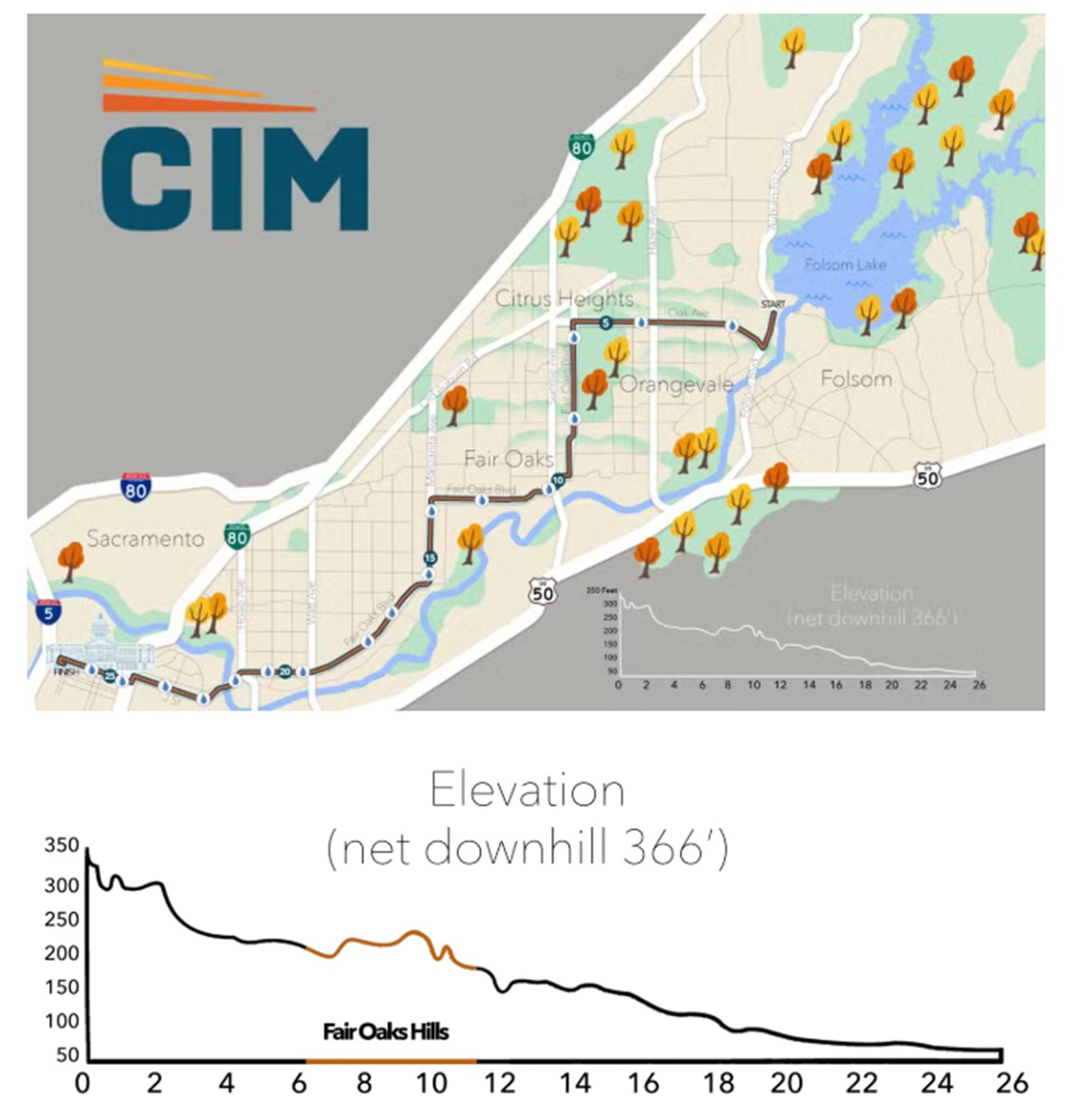
#3 Marathon Expo
The expo is located at the Sacramento Convention Center and opened during these times:
- Friday, December 4 12:00 pm to 7:00 pm
- Saturday, December 5 9:00 am to 5:00 pm
All runners must pick up their race packet at the Expo. No pickup is available on race morning.
If you can’t make it, someone else may pick up your bib for you. They will need a copy of your ID and your unique QR code.
The Expo will be filled with lots of vendors, official CIM merch, and speaker panels. You’ll also be able to meet the official CIM pace team leaders if you have questions before race morning.
NOTE: Gear check happens at the Expo and not on race morning. Plan ahead to drop your bag during expo hours if you want it back post-marathon.
Expos can have a lot happening, so don’t forget your job is NOT TO BE ON YOUR FEET ALL DAY.
#4 Plan for Race Morning
When: Sunday, December 6 at 7:00 am
Race morning will start early.
The marathon begins at 7:00 am, but you’ll need enough time to get to your bus pickup location, ride to Folsom, and get settled at the starting area.
You cannot drive to or get dropped off at the CIM starting line.
Bus transportation is free for participants, and your race bib acts as your ticket.
If you’re staying in downtown Sacramento, buses are available near the SAFE Credit Union Convention Center. CIM also offers bus pickup options associated with other areas, including Point West and Folsom.
Check your transportation plan before race morning and give yourself plenty of time to get to the start.
This is not the morning to sprint out the door to catch a bus when you’ll still have 26.2 miles ahead of you.
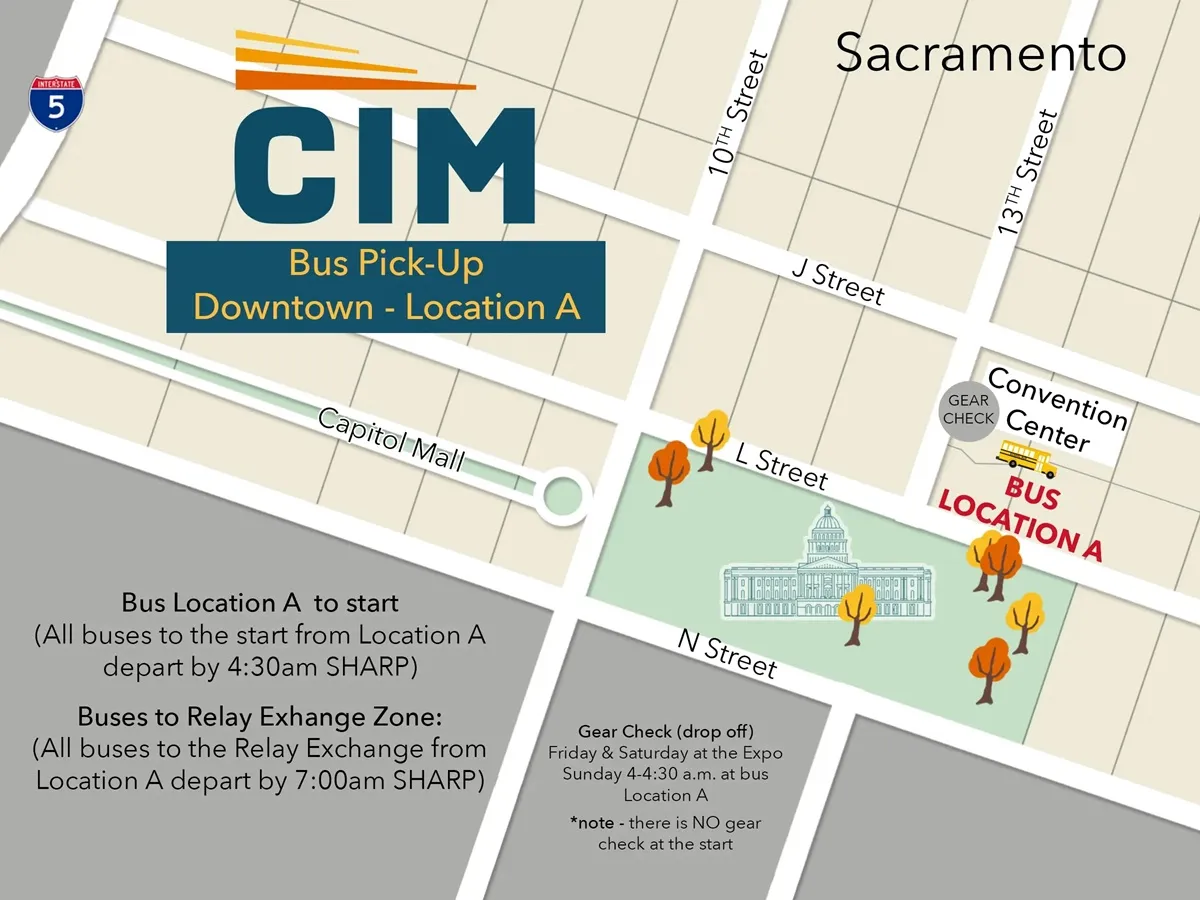
There is no gear check at the start on race morning.
It’s only available at the Expo and during bus loading at the Convention Center location.
If you want something waiting for you after you finish, make sure you’ve used one of the available gear check options beforehand.
Not sure what to put in your gear check bag? Check out this marathon checklist so that you’re fully prepared.
Corrals
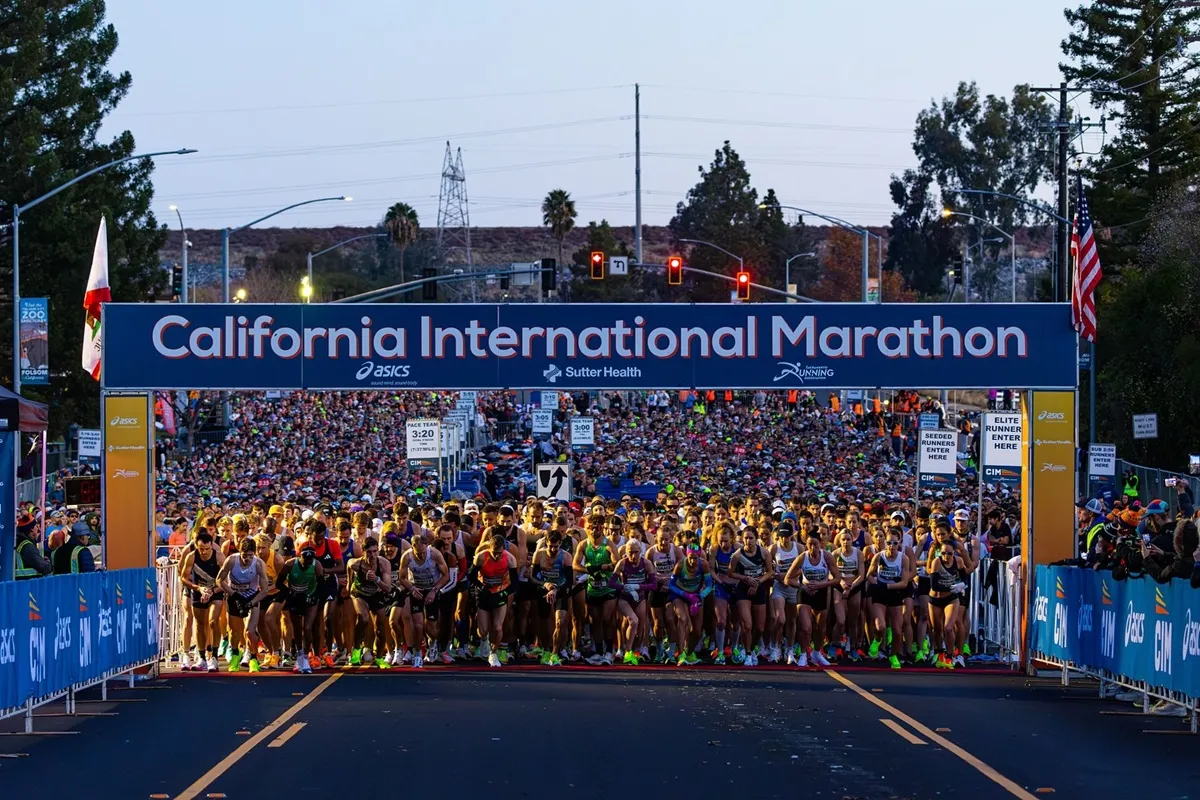
CIM doesn’t use traditional corrals; instead, it has self-seeded areas based on expected marathon finish times.
- green sub 2:50
- orange 2:50-3:05
- yellow 3:06-3:15
- light blue 3:16-3:40
- pink 3:41-4:00
- dark blue 4:01-4:30
- purple 4:31+
These stage area ranges are based on information from the CIM website in September 2026. If this changes, we will make updates.
#5 CIM Course Strategy
Let’s break down the key things to know over the 26.2 miles.
Usually even pacing from start to finish is the ideal way to PR, but not so much with this course.
Instead, you’ll be focusing less on individual mile splits over breaking it up into sections and focusing on effort. Let’s break this up a little bit more.
Course Support
You’ll find 17 aid stations throughout the course with water and Precision Hydration.
Fuel (Precision fuel and fruit) will be available at three stations:
- Mile 6.4
- Mile 13.6
- Mile 21.4
There will also be a few porta-potties every few miles along the courses.
Remember nothing new on race day, so if you do not want to carry a pack or handheld on race day, practice with what’s being offered on the course so that there are no surprises or unwanted bathroom stops along your 26.2 miles.
Miles 1-5
You know how the first few miles of any race go, especially the marathon.
You’re tapered. You’re excited. You’re nervous. You’ve got hundreds of runners around you, and suddenly the pace you’ve been training for feels easy…maybe you’re even running a little too fast.
This is where you need to remind yourself to be patient and avoid starting out too fast.
The beginning of CIM includes some rolling hills, you may find yourself up to 15 seconds slower than goal pace. That’s ok, we are settling in to the work and flowing with the effort of uphills and ease of downhills.
The goal is to avoid spending all of your energy in the first 10k of the race; save that for the final 10k!
Limit Your Weaving
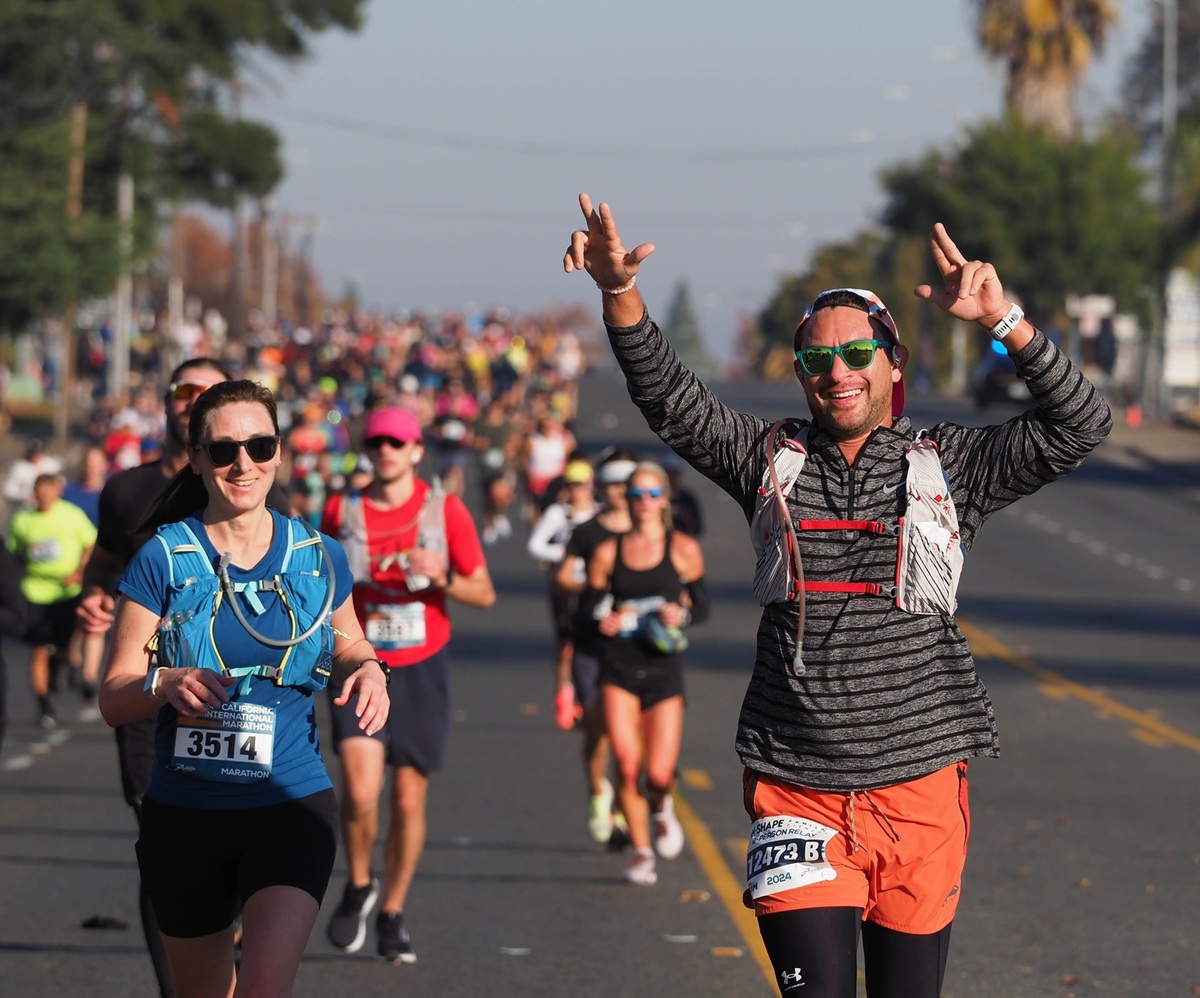
No matter where you start in such a crowded course, there’s going to be a need to pass people.
- Try not to make any massive weaves; this will add distance to your race
- Just move slightly to the side and keep going
- If you run into a large pile-up, it’s probably a pace group. Try to move to the side to get away from the pacer if you don’t like all the jostling.
Miles 6 – 21
Now we are looking to find yourself hitting more of an average goal pace, so maybe you’re 10-20 seconds faster on the downhills and 10-20 seconds slower than goal pace on the uphills. It’s steady work, over massive changes in pace.
The rolling hills continue throughout much of the course, so this is where those hill workouts will come in handy.
Try not to attack every single hill. Keep your effort steady and allow yourself to slow down on those uphills. Think of a mantra to use during this part of the course to keep yourself focused.
It’s important to not to over run the downhills, this will still pull from your energy back and overwork muscles. Relax, roll your shoulders back and down, and let gravity help you settle back into your goal pace rhythm.
You can expect rolling hills for pretty much this entire section of the race, so keep that in mind when adjusting your effort.
Final 5 Miles
The real opportunity comes after about mile 21. The course gets flatter, and if you’ve managed the early miles well, this is where you can start increasing your effort and gradually cutting down your pace.
Think of CIM as a race where you want to bank energy early, not time. If you reach those final 5 miles feeling like you could have run faster earlier, you probably paced the first part correctly.
Don’t turn up the pace too quickly, but instead again think about this in terms of 5-10 seconds per mile faster.
Once you get into those final miles toward the State Capitol, you can start to give it whatever you’ve got left. Again, it’s not a sprint and you MUST have been fueling well along the way to have energy left in your legs.
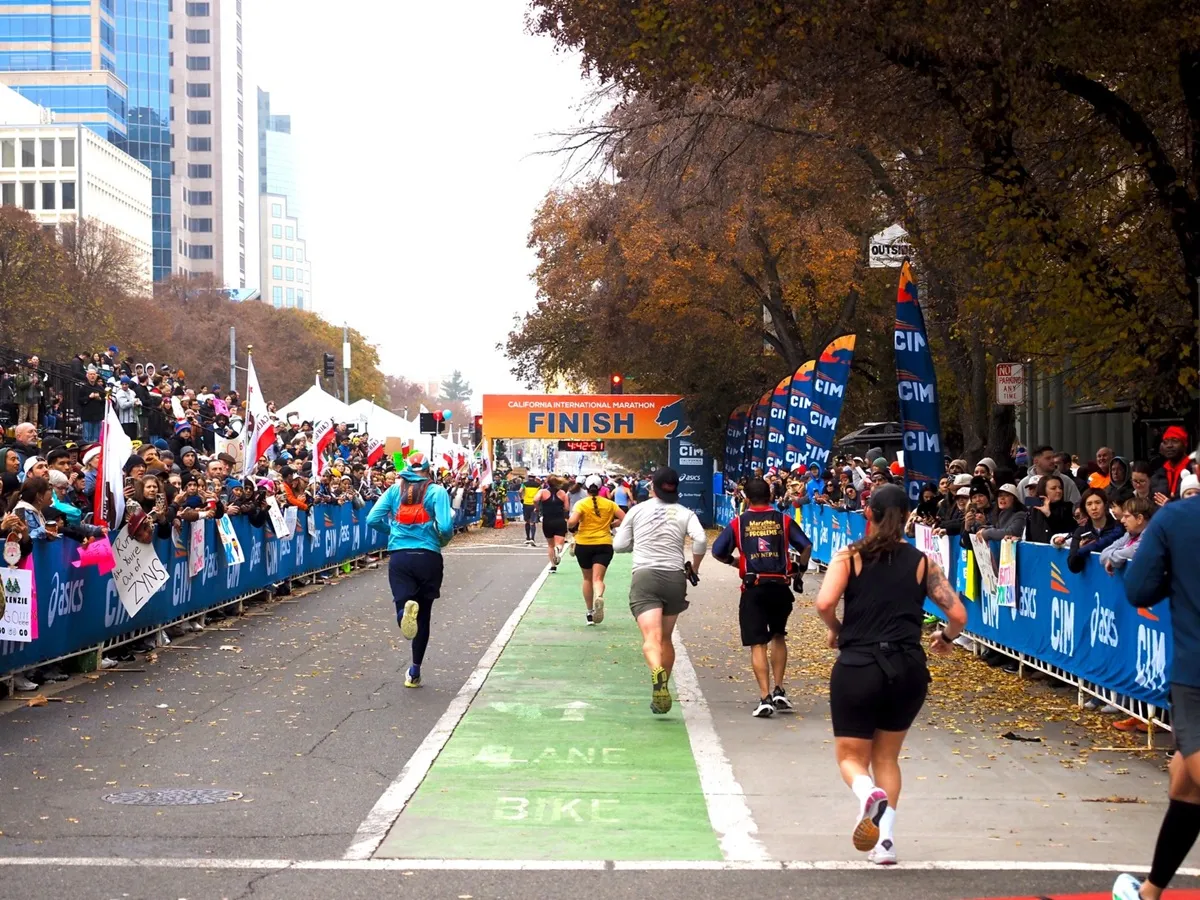
The last bit to the finish line is lined with spectators cheering for all the runners, which is the perfect little energy boost.
CIM FAQ
When is CIM??
Sunday, December 6, 2026
Do you have to qualify for CIM?
No, you do not need to qualify to run CIM. However, this race does sell out very quickly.
How big is CIM?
The 2025 race had 8,168 official finishers. 10,000 runners were registered for the race.
Is CIM a downhill marathon?
CIM is a net downhill marathon with a total elevation drop of 366 feet.
But remember, that doesn’t mean the entire race is downhill. The first 21 miles are rolling hills before flattening out for the final five miles.
Is there a cut-off time?
There is a 6-hour course limit, which means runners need to average about a 13:44/mile pace. The start line opens at 7:30 a.m., and the finish line closes at 1:30 pm.
Can you defer your registration?
You can defer your registration only if you purchased the “worry-free entry.”
If you’re a standard entry, you can transfer your bib during the assigned window.
If you’re an unprotected entry, no deferrals or transfers are available.
Are there pacers?
Yes, an official pacing team has groups based on Boston Marathon qualifying times.
Pace groups range from 2:55 to 5:50 finish times.
How many aid stations are on the CIM course?
There are 17 aid stations. Each will be stocked with water, Precision Hydration, medical supplies, and porta potties.
Fuel and fruit are available at three of the aid stations.
Looking for what to read next?
- Registering for Your First Marathon? Start With These Tips
- Best Marathon Shoes for Beginners Who Just Want to Finish Strong
- Best Non-Plated Race Day Shoes | Proof You Don’t Need Carbon to Run Fast
The post California International Marathon | CIM Course Guide, Pacing and Race Day Tips appeared first on RunToTheFinish.
from RunToTheFinish https://ift.tt/fu9RWqw
Post a Comment
Post a Comment