Cross-training is an important part of staying healthy and keeping your running strong. But it wasn’t always talked about that way. For a long time, cross-training only popped up occasionally in training plans, usually as a way to help runners ease into higher mileage or mix things up a little….or if you were injured. 
The truth is that cross-training for runners, when done right, can have some pretty big benefits. It can help you run faster, go farther, and lower your risk of injury along the way.
For a long time, though, many runners used cross-training to avoid things like strength training, prehab, or stretching. Maybe that meant doing a yoga class every now and then or picking up a weight here and there, but usually the missing part was consistency.
And regardless of whether it’s running or cross-training, consistency is really what makes the difference when it comes to progress in training.
Let’s take a look at what cross-training actually means, and why it’s worth including in your training as a runner. And if you’re not sure which workouts to incorporate, we’ve got some suggestions for you, too.
What is Cross Training?
Cross-training for runners is any alternative, complementary workout or exercise that’ll improve your running performance. Think of it as workouts that mimic the movement of running but with less impact.
We’ve heard many folks lately say that we should stop calling it cross-training for runners and just call it training.
Fair enough, if you really want to run through your 50’s and beyond, then you need to do more than run.
Cross-training is utilizing your muscles in a variety of ways to help:
- Correct muscle imbalances
- Increase core strength for endurance
- Improve leg strength for endurance and speed
- Prevent injuries through stronger hips
- Maintain muscle mass (often lost with distance running)
- Ensures a full range of motion and flexibility for better running, endurance, and speed
Every cross-training activity has its pros and cons, but not all types of cross-training are good for runners.
What are the Best Cross-Training Workouts for Runners?
Let’s be honest, with distance running, there are only so many hours or energy left in the day for cross-training.
We love the following methods because they improve our running, which we find keeps many of us motivated to stay on track.
Strength Training for Cross Training
All of our athletes now know that strength training is no longer optional in their plans.
It’s a requirement because there is too much evidence supporting it as the best cross-training for runners.
It’s how we develop a stronger core, speed, endurance, and injury prevention. Plus, we know a lot of you start running with weight loss as a goal, and nothing is going to help that as much as strength training.
Strength training reduces injury risk, improves running endurance, and strengthens muscles often neglected or weakened by running.
You can also do compound exercises in your strength training that’ll target several big muscle groups at once. This means exercises such as weighted squats, lunges, and chest presses.
You don’t have to suddenly start CrossFit-type workouts to get results!!
Here’s a few ideas to get you started:
- Follow-along strength training for runners courses
- Bodyweight training
- Our favorite online strength training resources
- Upper body workout (helps power you up hills)
- TRX full body workout
Yoga for Cross Training
Try a Vinyasa-style class where the continual movement helps runners avoid boredom when transitioning to this slower workout style. Additionally, focusing on breathing can help you expand your lung capacity and keep you from feeling winded during runs.
Remember that Yoga can be an active recovery day option when you keep it low-key!
Not every workout you do needs to be hard, fast, or intense. Take this opportunity to slow down, let your nervous system calm down, and work through some tight areas that could lead to pain on the run.
Consider trying a Yin Yoga or Restorative Yoga class.
Read more on how yoga improves your running >>
Cycling/Biking for Cross Training
Head to a spin class, hop on a stationary bike to watch a TV show you wouldn’t otherwise or get some extra motivation by heading outdoors.
We get it, riding a bike indoors can sometimes feel pretty boring, and you may not stick with it. If you can, head outdoors where the scenery changes and you can feel the wind on your face (or maybe at your back, depending on the weather).
But you may enjoy spinning at home with the guidance of an instructor through an online platform like iFit.
Don’t be afraid to keep testing things to see what works.
Swimming for Cross Training
Swimming is another fantastic way to improve lung capacity and create core stability, which will help you run longer with better form.
The low impact cross training can be an amazing way to stay on track during most injuries or to get in a cardio workout when you might need a break from intense run training.
Because you aren’t putting stress on the tendons and ligaments, many endurance athletes have started to turn to aqua jogging. It’s a way to really build up the cardio system and head off injuries, particularly for those who notice injuries occur every time they hit certain mileage points.

Remember that this is cross training, so you need to weave it in to your schedule in a way that doesn’t exhaust you for the next run. If you’re already putting in tons of miles on the roads, consider if you truly need another cardio workout.
Many triathletes have expressed that adding in swimming or biking, improved their running overall. I think this goes back to simply giving the body a break from the intense pounding, while still getting in a great aerobic workout.
Jump Rope
Jumping rope is one of those underrated workouts that checks a lot of boxes: coordination, balance, endurance, and core strength. It’s basically a runner’s jackpot.
Yes, it builds endurance, but it also functions as a plyometric workout, which means you’re developing tendon stiffness through Achilles and ankles, working on cadence, and lower limb power. All of which play into healthy and fast running.
We love that this isn’t adding a lot of time to the week, but instead truly getting a lot out of a short duration. This could swap in for existing plyo, be added as cardio cross training or as noted thrown into some warm ups.
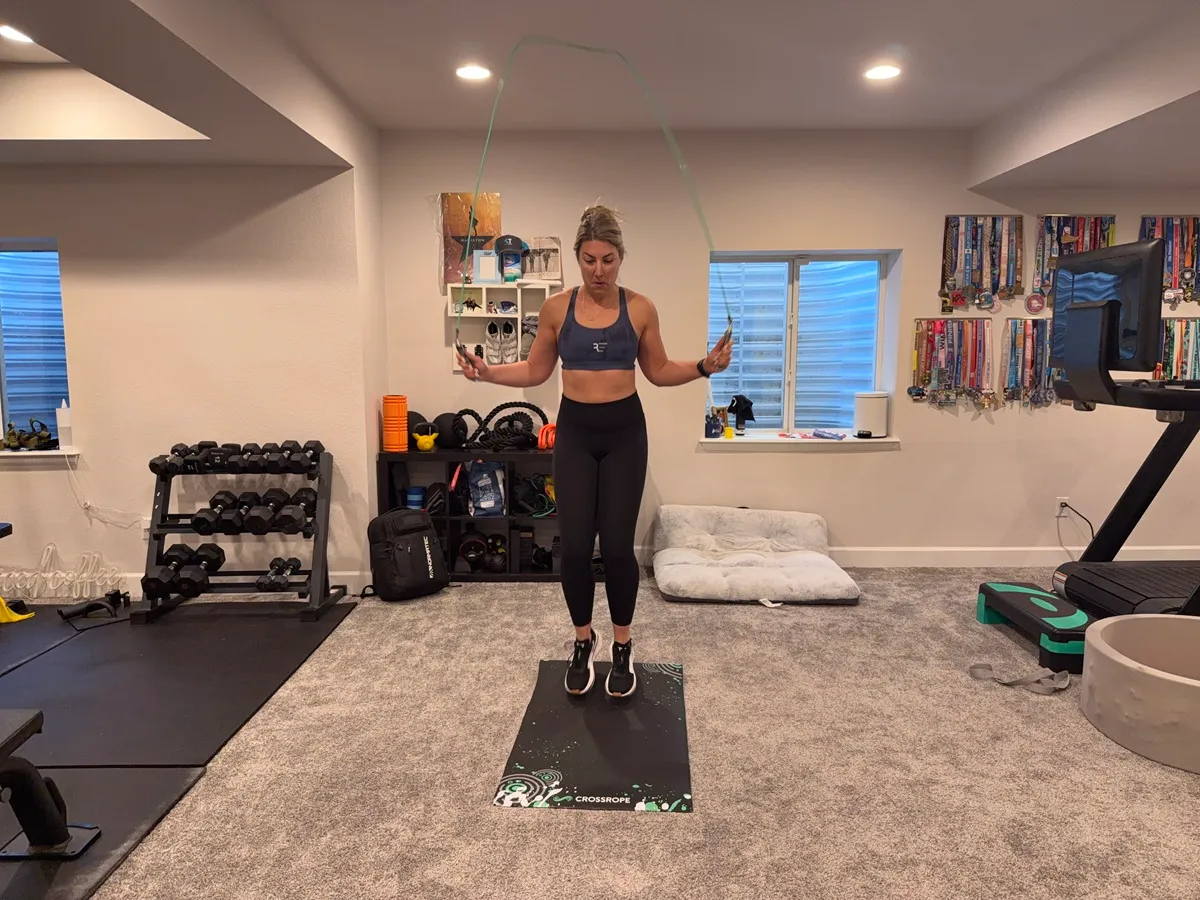
And with the CrossRope you can jump with the normal rope or go ropeless to make truly be able to jump anywhere! Trust us when we say you’ll still get quite the workout using the ropeless version.
Pilates for Cross Training
These workouts develop strength, flexibility, muscular endurance, coordination, balance, and good posture — with a much lower chance of injury than with other forms of exercise.
The discipline emphasizes correct form instead of going for the burn.
That correct form is going to help you maintain good posture while running, as well as learn how to fully activate your core muscles: hips, glutes, abs and back. Personally, I felt this most when doing a reformer class.
While they are more expensive than doing mat Pilates at home, it was worth the sessions I attended to learn some really great skills.
Circuit Classes for Cross Training
Feeling strong is very empowering and of course we need to get our strength training on to keep the hips strong, create arms that power us uphill and a core that will keep us from hunching over as we get tired during long runs.
In most circuit training classes, you’ll be doing a combination of strength, endurance, and plyometric style exercises. We absolutely need all three components as runners.
However, the timing of the classes in your marathon training plan is HUGE.
Because these classes are very intense, you are going to need to take out a day of speed work or switch to something closer to a 10 Day training cycle. This is to ensure that you are getting enough recovery between workouts.
If you stick to your standard marathon plan and add in 2 Circuit Training Classes each week, you are very likely going to end up overtrained and either not make it to the start line or get injured.
Instead, think of these as perfect during base building or as a once-a-week in place of speed.
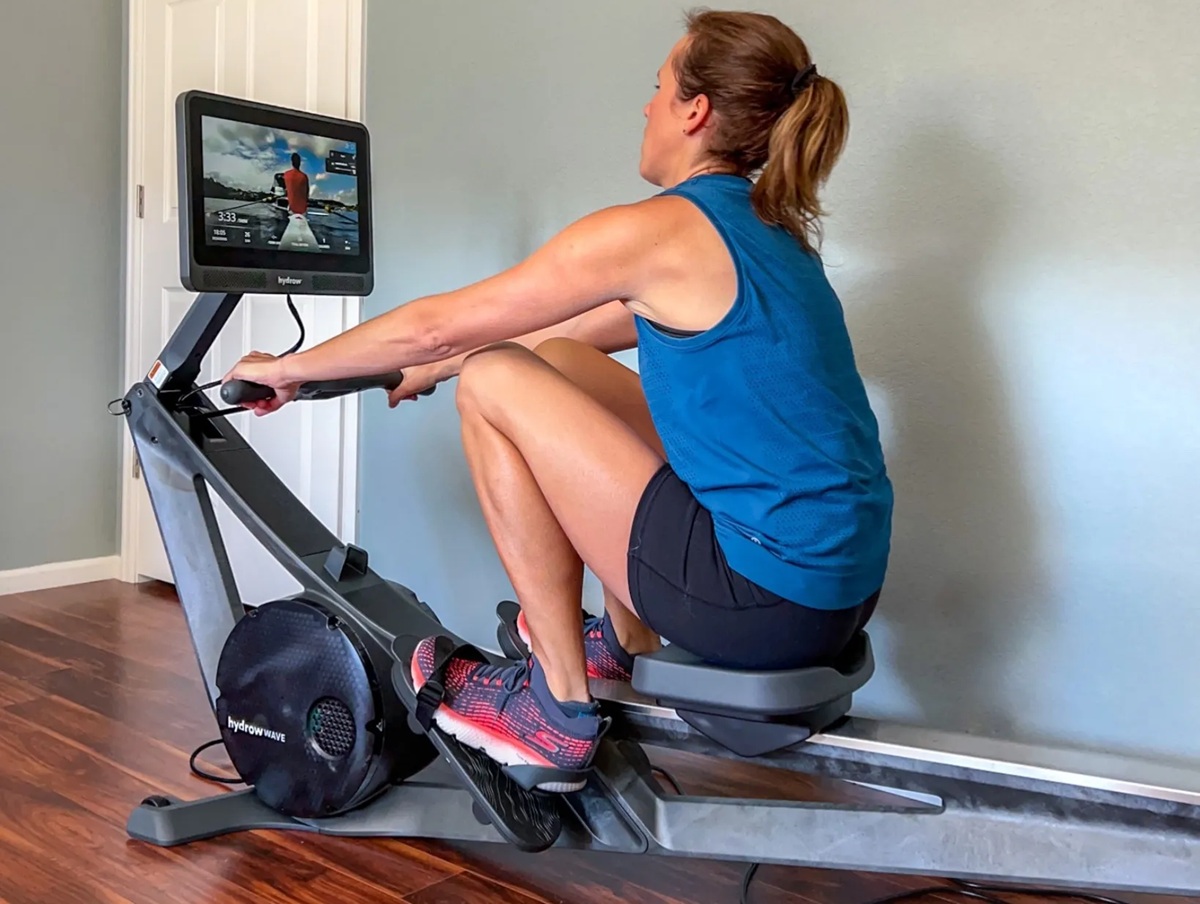
Rowing
While you may not do workouts as long on the rower, it’s a huge benefit for the power of your running.
In fact, we’ve gotten so many questions about it that there is now a full breakdown of rowing vs running for you!
Whether you use it for HIIT-style training or simply to work your full body in a different way, you’ll find the benefits are numerous and will leave you sore!
Are There Cross-Training Activities Runners Should Avoid?
There are certain cross-training activities that runners should avoid because they involve quick lateral movements that increase the risk of injury.
This means you might want to avoid exercises and activities that require fast movements with frequent changes in direction.
As running coaches, we love to see that you have a variety of interests. But if you go from only running to adding in a lot of these quick movements, it’s very easy to get an ankle injury. So, just as with your running, add them in gradually.
The reason for this is simple: since runners are used to moving in one plane of motion (forward), incorporating these activities too quickly and at high intensity can be harmful and increase the risk of injury.
Not all lateral movement is bad; in fact, it’s great and necessary. Just remember, we need to build up, so start with slow, controlled movements to strengthen muscles often neglected by runners.
How Does Cross Training Prevent Injuries for Runners?
Running involves repetitive movements that can lead to overuse injuries and muscle imbalances. The next thing you know, you have peroneal tendonitis or runner’s knee.
Cross-training can address not only those imbalances, but also promote active recovery to avoid overuse injuries and overtraining.
It also helps prevent injury by helping our skeletal system strengthen just as fast as our muscular system has, due to running.
Muscles adapt relatively quickly, but tendons and ligaments can take much longer.
The reason for this is that tendons and ligaments don’t have the same blood flow as our muscles do, so they take longer to adapt to the stresses they face while we run.
That’s why, if all you do is run and progress too quickly, you could easily end up injured. By incorporating cross-training into your training plan, you’re allowing your body to strengthen through different means simultaneously.
Our ankles, knees, and lower backs aren’t used to the repetitive impact running entails. But with cross-training, you’re able to improve endurance without overexerting your most vulnerable joints, muscles, and connective tissues.
Okay, that was a lot, but we hope you found some new cross-training workouts here!
Looking for what to read next?
- Can Cross-Training Make You Faster?
- Does It Matter if You Run or Lift First? Our Answer May Surprise You
- 8 Best Gym Shoes (Why Most Running Shoes Don’t Work For Lifting)
The post 9 Best Cross Training Workouts: Complete Guide for Runners appeared first on RunToTheFinish.
from RunToTheFinish https://ift.tt/yf2aFLA
Post a Comment
Post a Comment